
World first
First flyby of Mars and first close-up photos of another planet
The claim: First spacecraft to fly past Mars and send back close-up pictures of another planet
Verified
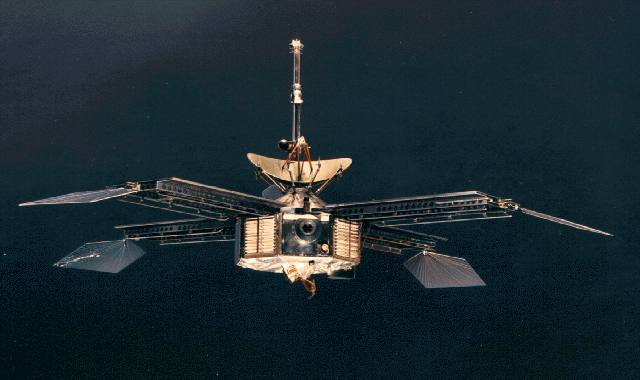
Early on July 15, 1965 (UTC), on the evening of July 14 in the United States, NASA's Mariner 4 passed 9,846 kilometers (6,118 miles) above Mars. It was the first spacecraft to fly past the planet and the first to take close-up photographs of another planet. Earlier Soviet and American attempts to reach Mars had failed.
Mariner 4 launched from Cape Canaveral on November 28, 1964, and reached Mars after a 228-day trip. It stored its pictures on a tape recorder and played them back to Earth slowly over the following weeks: 21 complete images and part of a 22nd. They showed a cratered surface that looked more like the Moon than the canals and vegetation some had imagined, and the spacecraft measured an atmosphere far thinner than expected. The results dashed many scientists' hopes that Mars was hospitable to life.
Dig deeper
Questions to explore if you want to go further. Each search link opens the question in ChatGPT in a new window.
Sources
On the Bookshelf
Suggested reading: The Search for Life on Mars by Elizabeth Howell and Nicholas Booth (2020). Read the booknote ›
Suggested reading: Discovering Mars by William Sheehan and Jim Bell (2021). Read the booknote ›
Suggested reading: Destination Mars by Rod Pyle (2012). Read the booknote ›
Suggested reading: The International Atlas of Mars Exploration, Volume 1 by Philip J. Stooke (2012). Read the booknote ›
Suggested reading: On Mars by Edward Clinton Ezell and Linda Neuman Ezell (1984). Read the booknote ›
Spot an error? Tell us. Corrections are made in public.